What Horses Teach Us About Regulation, Trust, and Performance
Equine-assisted intervention is not a single approach, nor a romantic accessory, nor simply riding a horse (as might be the case with rehab, for example, by Physios or OTs). It spans a range, from hippotherapy and horse-based reading programmes to equine-assisted psychotherapy and broader, nature-inspired interventions, each with unique treatment objectives and clinical uses.
And what unites them is not technique, but relationship.
Horses, like the natural environments they inhabit, create conditions where the nervous system can soften before it submits to change. For some clients, this becomes a gateway into therapy when traditional models have failed. For others, it deepens work already underway. It is not for everyone, but for the right person, it can be transformative.
The Workshop That Changed Everything
My first real encounter with equine-assisted psychotherapy came through an introductory workshop I attended. I arrived with professional distance intact, notebook in hand, intending to observe rather than take part.
That plan did not last.
Before I could disappear into the background, I was ‘volunteered’!
I was instructed to write down my worries and concerns on slips of paper: health, work, relationships – each one then folded and attached to a ball. I was handed two strings to hold, one from either side of the ball, and told to release them only when I was truly ready.
So, there I stood, in an arena, gripping a physical representation of every apprehension I was carrying.
A horse began pacing beside me. Restless. Agitated. At first, I barely noticed; my attention was focused inward. Minutes passed. Then something shifted. I exhaled. I let go.
At that exact moment, the horse stopped pacing. He walked toward me and stood calmly alongside my body, grounded and still. The facilitator looked stunned. She explained that this horse had a chronic right-hip issue and rarely moved in that manner. My stomach dropped. Within the next two weeks, I was scheduled for right-hip surgery, something I had barely allowed myself to acknowledge. Nothing in all my years of therapy training had prepared me for that singular moment.
As Dr Sharon Boyce, a Johannesburg-based counselling psychologist with a PhD specialising in equine-assisted positive psychology, reflects: “horses respond not to words, but to states. Breath, posture, muscle tension – what the body communicates before language ever arrives.”
What the Body Learns Before the Mind
The evidence-based part of me needed answers. I enrolled in certification training in equine-assisted psychotherapy. What I learned grounded the experience without diminishing its power.
Horses are prey (hunted) animals. Their nervous systems are exquisitely attuned to their environment. They register micro-shifts in attention, tension, and emotional coherence. They are receptive to when a human regulates, and they respond. When a human is fragmenting, they reflect it back.
Dr Boyce describes this as ‘relational honesty.’ In her work with tweens, adolescents, adults, couples, and families, she integrates approaches such as logotherapy, emotion-focused therapy (EFT), dialectical behaviour therapy (DBT), and narrative work – supported by the horse that delivers the feedback, instantly and without judgment.
I learned that you cannot fake confidence next to a twelve-hundred-pound animal.Presence is not optional. For the first time, I understood what athletes mean when they talk about being ‘in the zone.’ That quiet alignment where effort drops away and clarity takes over.
This was regulation, not insight. And it was immediate.
Where Therapy and Performance Intersect
What surprised me most was how closely this encounter mirrored the language of high-performance sport. Emotional regulation under pressure. Rapid decision-making. Trust between bodies moving together.
Mandy Laskey, an educational psychologist with over twenty years of experience in private practice and a background in teaching physical education, clearly sees this intersection. Through her non-profit organisation Heart’s Haven Equine Assisted Psychotherapy Centre, horses are part of the therapeutic team working with children, adolescents, and families.
Laskey has frequently observed that young people lack the vocabulary to express what they feel. Horses go beyond words, providing emotional safety first, before any skill, insight, or performance is required.
This is an essential aptitude in high performance sport – ‘Regulation’ is not a ‘soft’ skill. It is the foundation upon which focus, resilience, and positive execution is built. Before athletes can perform under pressure, their nervous system must feel safe enough to engage.
The Question of Adolescents and the Need for Speed
Not all young clients respond equally to equine-assisted psychotherapy. I have noticed that some adolescents, particularly those with ADHD or oppositional traits, struggle with the slower, reflective pace. It can feel too obviously therapeutic. This tension led me somewhere unexpected: horse polo.
Working with a polo team, I saw the same principles in motion, but at speed. Emotional regulation while moving. Trust between rider and horse. Decision-making under pressure where hesitation has an immediate cost.
For some adolescents, this is exposure therapy disguised as sports. The teenager who refuses counselling might show up for training. The young adult who resists sitting still could find stability through movement, rhythm, and embodied challenge.
There is no established manual for this type of therapeutic intervention. The risks, safety, liability, and physical demands are real. What I am exploring is not a protocol, but a possibility.
This distinction matters.

Conclusion
What resonates with me the most are not the theories, but the people. I have been privy to the stories of my colleagues and clients:
– I think of the selectively mute child who never spoke in a therapy room, yet began whispering requests to a horse, asking him to move closer, to wait, to stay. Speech emerged not because it was demanded, but because the relationship made it feel safe to vocalise.
– I think of children who had cycled through multiple therapists without a breakthrough, labelled ‘resistant’ or ‘shut down.’ In the arena, there were no questions asked. These clients groomed the horse. Played games. Learned to read subtle cues. And slowly, almost imperceptibly, words followed action. Conversation arose from connection, not pressure.
– I think of the story of street-involved children who had never experienced consistent kindness. For them, the horse became the first relational being that responded without threat or agenda. Through feeding, grooming, and shared presence, something foundational shifted. Trust, once earned, began to generalise beyond the arena.
Across these experiences, the benefits appear less dramatic, but more enduring: a greater sense of well-being, reduced trauma responses, and a growing belief that life can feel different. Many clients report a renewed sense of meaning and purpose; an embodied understanding that regulation is possible and that support can be sourced. For children who have experienced adverse events, this work often becomes the first place where trust is safely re-learned. Horses allow young people to practise asking for help, setting boundaries, and staying with difficult emotions, being held by both the animal and the environment.
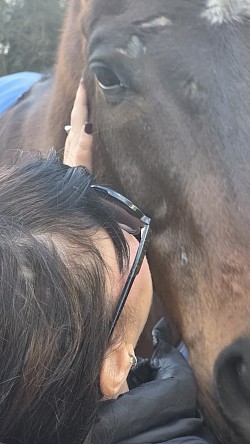
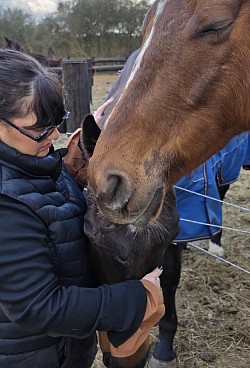
The work is relational at its core. Horses and nature become co-regulators, mirrors, and companions. Clients are invited to explore their inner worlds through story, how they understand themselves, others, and the world around them, and to experience those stories differently through embodied interaction.
Different theoretical approaches sit comfortably within this affective domain. Person-centred, narrative, emotion-focused, logotherapy, and trauma-informed models are not replaced, but are enriched. The arena becomes a living context where insight is felt, not explained. Through relationships with self, with others, with the world, and with horses, new possibilities quietly take shape, and regulation becomes the foundation for focus, resilience, and performance.